Showing posts with label yeast-centric. Show all posts

Sunday, April 5, 2015

Brett Caison


Awhile ago I did an interview with award winning homebrewer Keith Ciani on staggered fermentation, it rocked my socks off.  As a homebrewer I have watched my journey ever evolve as my "tool kit," was reshaped (by Crooked Stave), smashed apart (by Devil's Purse brewer, Mike's Stout Saison Brett), and rebuilt again (still working that through). Whether it's mixed cultures, tertiary fermentation profiles, blending, cross-style brewing, staggered malt additions, seasonal/historical brewing or caramelizing raisins in brown sugar, my brewer's mind is constantly trying to unwrap itself from the constraints of style and delve into the never ending abyss of perception.

The interview focused on how a staggered fermentation can lend to getting the character you wish from one yeast, yet the attenuation of another.  So I thought to myself, how would this apply to flavor profiles, and my first thought was of my old friend Brett. What I came up with is to follow.

My plan is to make a Brett-Saison, but instead of going the "funk," route, I am going to use the yeast character of a "100% Brett fermentation profile" to compliment the profile of a Saison fermentation.  Saison 565 may not be the best choice for this and I'm sure to find myself doing this more down the road with other strains, in fact, I must, but for now the high ester Saison characters of 565 will due fine.  Couple that with the tropical fruit/tangerine of Brett C and I think we may have a winning combo!

A small caveat, Brett C is "usually," not really considered a "primary fermenter," although I was happy to find other wild and crazy brewers testing the waters; For instance, fellow beer writer Derek Dellinger.  With that settled, it is Spring, the season of Saison (apropos), and being that Brett C's character as a primary fermenter includes words like tangerine, I am easily sold.

Let's Begin

Stats

OG - 1051
FG - 1005ish
ABV - 6.1%
BUGU - .25 - .5

Grist
American Pilsner - 8 lbs
White Wheat - 1 lbs
Carapils - .5 lbs
Acidulated - .5 lbs

Mash - 152

This grist and mash were engineered with three end goals in mind, body, alignment with the citrus flavors,  yeast esters, and quick turnaround time.  First, the wheat and carapils will add perceived body to a beer that will attenuate highly.  Second, the acid will compliment those citrus flavors, bringing the acidity of the beer up (or the pH down) to our mind's perceived acidity of a citrus fruit.  Read more on this concept here and scroll down to the section labeled "Acidity."  In turning the beer quickly, I don't need to mash ultra high as I would with a beer I intend to age with Brett, but I do want some portion of additional dextrins to continue to add to my perceived mouthfeel, so 152 it is.  Middle of the road.  As a side note, Mike Tonsmeire also notes the presence of lactic acid is a catalyst to the fruity ester ethyl lactate:
"I added a half pound of acid malt after starch conversion to provide some lactic acid for the Brett to create the fruity ester ethyl lactate." 

Fermentation Profile (the whole shibang): Split batch possibility (No fermenters left! Ran with the staggered pitch)
1. Staggered Pitch Saison third gen slurry, then Brett C.
2. Mixed culture.  Both pitched at the same time.

I built up a vial of Brett C in 3 steps over a period of a month and stored at room temp per the suggestion of Chad Y in his interview at the BN.  I tossed that slurry into a 250ml starter at 1040 with very little nutrient (he actually says none is needed, I just couldnt help myself), and stepped that to 2L after 5 days then let that run for 5 more days.  In the meantime, I simply brewed and pitched slurry from my Rye Saison which went to my  cool fermentation Saison at 70 degrees.  As soon as I have airlock activity I'll pitch the starter of Brett.  No aeration is needed at this stage as the Brett will be happy to ferment in an anaerobic environment, then off to a warm water bath of at least 80 degrees.

This process will allow for the Saison to get a head start on ester production and then the Brett will have plenty of sugars (near a full fermentation) in a truly anaerobic environment hopefully leaving us with a dry, tropical fruit/tangerine Saison that has all its flavors derived from the yeast!

Hops
Challenger (or Santium) at 5 targeting .5 BUGU.  Mike and Matt from Devil's Purse kindly donated a pound of each to the Brew Farm Group, perfect.   I was thinking Nelson may be a good choice here too, complimenting the fruit.  Layer aroma with floral, or compliment with fruit?  I'd bet a winner either way!  Bottom line, this is a yeast-centric beer, let's keep our eyes on the prize.

Experiment

Split the batch to two 3G carboys and pitch the Saison and Brett at the same time in one and stagger the pitch per this article in the other.  A Triangle Test is a great way to see if you have created a measureable difference.

Pre-Brew Day

Initial Brett C build
11/10/14 - Brett C vial that was kept on shelf to 500ml 1040 starter on stir plate. and no nutrient. Kept at room temperature room for 8 days.

11/18/14 - Stepped up to 1300 ml and back on stir plate.  Smelled great, looked great!

12/3/14 - off stir plate and split to three 400ml boiled jars.  Stored at room temp per Chad Y. Resulted in thick 50ml slurry.

Brett C rebuild:
3/26/15: Took two beautiful 50ml slurries to 250ml 1040 wort with a little nutrient on stir plate at 67.
3/31/15 - Stepped - adding 1750ml of 1040 with smidge of nutrient, CaCl, Gypsum and baking soda to RO water. Result 2L total volume.
4/1/15 - high krausen, white foamy head.

Brew Day: 4/4/15 w/MoBigs

Strike - 4G at 162 - landed at 151. 60 min mash. 90 minute boil.  OG - 1048.  Pitched 3rd gen Saison slurry, 200ml (it's all there was) at 70 degrees @ 1730.  MrMalty would say this is 50% of target pitch.

D1 - 4/5/15 - 0900. Krausen had formed and beer was jammin.  Pitched entire 2L starter and placed fermenter in 80 degree water bath.  Aquarium heater set to max to 1keep above 80.
D4 - krausen dropped and airlock activity down to 1/5.  Taste is on a good path.  Brix - 5.2.  1.003!  Sooo, that may explain the big reduction in airlock activity. That's a heckuva 84 hour party!
4/10/15 - 1/5 - 80 degrees.
4/15/15 - moved to room temp (65-67)
4/25/15 - racks 1G to 1.5lbs fresh diced rhubarb
5/15 - bottled with sugar tabs
7/13/15 - this is an epic base beer for so many fun brews!  Pale straw. Dry. A very light saison citrus and spice in the aroma which seems to be getting eaten up as the beer progresses!  Far more Saison esters 6 weeks ago.  Carb is still increasing. Solid body, very light an epically quaffable.  The Brett character of the primary ferment is very subtle on the fruit.  Highly complimentary.   I love this beer and see many iterations...Next time try upping the acid malt to 1lb and/or a straight mixed culture.

Monday, January 19, 2015

RyGasm Saison 1 (2015)

RyGasm could be viewed as the first beer I’ve reworked within the same year.  Apparently it takes pure frustration in order to get my bones in gear to dial in a recipe.  Nonetheless here we are.  As we saw in my Rye Saison post from not so long ago, I was inspired by a spicey and balanced Rye Saison I had in CA. My attempt at this brew fell far short of my personal mark, and I blamed my extract recipe for this, mostly.  Ironically, I am still doing a partial mash brew here as I have a can of PIlsner Malt burning a hole in my fridge, and this is the perfect time to get it in the mix (pun intended).
In the meantime I did some more research in an effort to unlock this magical grain and discovered a great little ditty in Radical Brewing which described a few fun facts and tips:

  1. Glucans - the sticky stuff which can make Rye a lautering nightmare
  2. Capping at 20% grist is common, above this and you’ll have to employ all your best techniques to get the wort to the kettle.
  3. Unmalted Rye is best utilized by cooking separately.  Other sources state the use of a crockpot is highly efficient in extracting the character of the grain.
  4. If mashing directly, a 30 minute 95-100 degree F glucan rest is ideal
  5. Use rice hulls and sparge slowly. (Or if you forgot rice hulls like I did just add a couple pounds of uncrushed 2-row and mix.  Worked like a charm...but still take your time)
  6. Keep that mash temp at 170 as long as possible to make the wort as “slick” as possible.

Moving forward I decided to really go for it on this brew, why not!  Unfortunately my Crystal Rye didn’t show up in time (it got there 3 hours late), so I have one more adjustment to make for the next version of this brew - perhaps a lucky twist of fate.  That aside let’s begin.

Stats
OG - 1052
FG - 1008
ABV -
IBU - 18
BU:GU - .35
Color - 7

Recipe

Pilsen Extract - 3.3 lbs (35%)
2-Row - 3 lbs (32%)
Rye Malt - 2 lbs (22%)
Flaked Rye - 1 lbs (10%)
Homemade Candi Sugar (Amber) - .5 lbs (5%) *note to self. Always have simple sugars prepared before boil begins.

Hops
Fuggles (4.5%) - 1 oz - 60
Yeast - WLP 565 - 100ml of slurry straight from zero gen starter.  400ml of thick slurry from second gen off last Rye Saison.

Water - 2.5 tsp Gypsum

Mash  - 1.5 qt/lbs - 147 - 75 minutes

Boil - 90 minutes

Candi Sugar - using straight lemons you want 18x’s the request for pure citric acid. So 1/8th tsp citric acid equates to 2.25 tsp real lemon juice. This was added to .5 lbs dissolved sugar in water.  Simmer until you get desired color, in this case about 20 minutes did the trick.  Then straight to the boil.

On the fermentation I called in for advice from an excellent brewer I have come to know as the Cool Fermentationist.  This cat has been “experimenting” with sub 60 degree Ale fermentations since the beginning of Winter with great success!  The beers he is turning out are clean”er” as you would expect, but when it comes to a yeast like Saison, what you find is the scales tipping more to a light citrus and spice character, which I think brings the peppery spice more to the forefront.  Rye, spice, perfect, lets do this!  

How do you get a Saison yeast to finish in such cool conditions?  Pitch a Lager sized pitch of Ale yeast for your cool fermentation and let them ride! He says it takes maybe an extra week or two, but to have faith.  

The profile he suggested was a room temp pitch and when you have activity move ASAP to your cool fermentation station.  In my case this is my basement which is sitting at 61 degrees.  Ferment to terminal FG (min 3 weeks) and then move to room temp again for at least 48 hours (diacetyl rest).

So thats what I did.  In my case I pitched at 80 and after 12 hours I was already at high krausen (I was sleeping when they perked up so this was my ASAP).  Moved the beer to the basement and after another 12 hours she was sitting at 64 degrees in a 61 degree room.  And there she sits.

I’m hopeful to find myself with a Saison that is dry per the style, and having found a balance between the citrus and spice of the yeast and the Rye spice.  I am happy about the 50/50 base malts as I find Pilsner to have a little too much “bite” as I like to call it.  Something a little more rounded suits me just fine.  And lastly, I will of course be throwing Brett at some of it as well, because Brett is always a good idea.

Brew Day

1/8/14 - With Mikey Brubaker.  Details above but 147 (75 mins), slow lauter (used 2-row to aid in grain bed filtering), got great efficiency due to reset of crush.  90 min boil. Cooled to 80, BIG pitch and quick start.  

12 hours - high krausen and huge activity - off to 61 degree room.

D1 - 5 - 65 (in 61 degree room) - added blow off tube.
D6 - 1 - 61
D10 - 0 - 61, plan to take first gravity at 21 days. (1/29 min). Once terminal bring upstairs and warm to 70 (if possible, for 3 days).

2/5/15 - brix: 6.6 ... FG 1010! - Up to 65 degree room.
2/10/15 - kegged. Yeast harvested.

Tasting Notes
2/10 - force Carbed at 30psi and shook 5 min then left at 40degreed at 16 psi targeting 3L. Needs time. Initial tasting after carb the brew is beautiful and the yeast character restrained but not subtle. I can't pick out the rye, once again...also it's not quite as dark as expected but a nice dark Orange-Amber hue. 

3/5/15 Added 1.5 mango puree and squeeze of one like to 1G pull.

3/12/15 - bottled remaining of keg. Kegged mango. DELISH! Need I say more? Poured mango beer through muslin bag direct to keg and purged/Carbed to 16.

Tasting Notes by The Cool Fermentationist - 3/18/15 - 
It was beautiful, vibrant orange with a huge white head.
The bottle was a bit of a gusher, but once I got it in the glass it was fine.
I really liked the high carbonation. I think it helped to dry out the beer a little.
Perfect saison aroma. Slight tropical fruit aroma, which I would’ve thought came from the hops had I not known about the mango.
Bits of mango, hops and yeast quickly settled out. I don’t mind that kind of thing as a drinker, but if it had been filtered I probably would have kept trying to figure out what was in it.
I would've guessed heavy on the Citra. What did you use for hops?
I love the spice yeast bite. That is followed by the sweet, but surprisingly earthy flavor of the mango.
When it was coldest, that bite and flavor were very balanced.
As it warmed up, the sweetness started to take over.
I’d be really curious to see where this would go with an earthy, pungent hop like your Chinook.
If this came in 6 packs - I’d be buying it!
Very well done.


Saturday, December 13, 2014

LactoFest 2014 - The Redeye'd Berliner (1 and 2)

With Captain MoBigs at the helm, we have set out to dive into Lacto via the ever glorious Berliner Weisse.  As stated in the name this brew historically originated in Berlin (so we will look to a Berlin water profile).  A brew which is characterized by low ABV, sour (or at least very tart) and, of course, highly delicious; it was time to take the plunge.  A few things we needed to understand better before driving down this curved path was Lacto and various process variations.

 By the way, to make these beers, the brews were bottled and buried in dirt during spring and summer to keep the temperature up which effectively promoted the acid production/fermentation.  The creativity of the men and women who came before us is astounding, motivational and just plain old awesome!

Moving on, generally we scoured the www (per the usual haunts), themadfermentationist.com, HBT and all the random articles including but not limited to a little gem by a fella who correlated CO2 scrubbing with carbonated water.  Brilliant!

First, some keywords:
Lactobacillus - our new Buggy
Anaerobic - an environment devoid of oxygen
Lactic Acid - the portion of what makes our beers "sour" and is a result of fermentation with Lacto.

Some key points:
Lactobacillus
  • produces lactic acid and CO2
  • found on skins of raw fruit and WLP vials labels "Lactobacillus"
  • alcohol tolerance at 8%
  • Traditional fermentation time (optimal growth) 4 days@ 60-140F.
  • Will be restrained above 8 IBUs, but max 5 should be the target.
  • will produce without oxygen but prefers reduced levels
  • Acid production is correlated to temperature with max occurring at 98 ("the human intestine temp"), therefore we can extrapolate you'll get diminishing returns up to 140.
  • Acid production is greatest during primary fermentation and subdued during refermentation.
  • Hop acids (>8) and alcohol (>8) reduce acid production
  • ceases production below 3.8ph

OK, we have laid down some great info, now we have to apply it.

Let's do this chronologically, yeast/bacteria. In order to pull this off we will need lots of both.  

The building of Brett C and Troix
A month ago MoBigs and I began growing up WLP Brett C and Brett Troix vials in a two-step starter. My notes can be found here (he ran down a very similar process with a similar result):

11/10/14 - Brett C vial that was kept on shelf to 500ml 1040 starter.  Stir plate, no nutrient. Kept at room temperature room for 8 days.  Saw solid activity and characteristic settling after.

11/18/14 - Stepped up to 1250 (boiled too long, was going for 1500) anyway, stepped up to 1250 ml and back on stir plate.  Smelled great, looked great!  All was done at room temp and repitch was of room temp wort.

12/3/14 - off stir plate, mixed and split to three 400ml boiled jars and a vial.  Stored at room temp per Chad Y.  The jars are showing a beautiful straw hue, and the yeast is thick and clean.  The cake is what you would expect from a harvested and washed Sach cake.  More Apples-to-Apples, the vial was filled with homogenous blend of the Brett in its solution and once settled filled in the entire concave portion of the vial as opposed to the WLP vial which had little to no depth at the vial's base. We made yeast make yeast.

Lactobacillus (see notes below)

Lacto Starer 1 was an amalgamation of quite a bit of reading.  After scouring the www Eric and I found what we thought to be a process that made the most sense for us.  Long story short, we are looking to create a mini-sour mash and use that mash to inoculate a full wort and get the lacto we have grown up souring on a larger scale.  A massive lacto-step-up if you will.  Much of what we found came from Mike at theMadFermentationist and here as well (per usual...thank you good sir!). Plus a nice experience from the author of Bear-Flavored, and here is what we ran with.

12/8/14 - 2L starter with 4oz DME (to target a 1020 wort).   No aeration (except for what naturally occured as we poured the starter to the flask) or nutrient. Airlock in place.  Carbonated boiled water and added a couple ounces on top of the wort/grain to add a buffer of CO2 over the starter protecting it from O2 and inhibiting acetobactor or creation of acetobactor.  Added .5 cup 2-row and 1/8th cup acid malt.  Now this was due to a note by Mike regarding foam stability which I mistook as being part of a starter recipe and was in fact part of a main recipe.  So, will that mess with our starter, well, it reduces the wort's pH effectively decreasing the "room" it has to work and sour the brew befiore it reaches its "terminal pH."  Not ideal, and will delete this add from the subsequent starters.

I "pitched" at 105 degrees and placed the flask in a small igloo cooler with 120 degree water and covered.  Will check twice daily and run off cold water from tap below and refill with hot water.

12/9/14 - temp at 90 in morning.  Added hot water and ran off cool, temp up to 120.  Repeated once more this day. 

12/10 - Idea to put flask to a crock pot on warm in play here.  Crock pot took temp to 140 (too hot, although this may work in other crock pots and would be an excellent process), took out of crock and put flask and water back into Eric's igloo cooler.  Grains on top and white foam present.  Little airlock activity but much activity within flask

12/11 - came to find all grains dropped and activity stopped.  Transferred to sanitized and purged jars and put in fridge

12/12 - Second starter - 1020 wort - 2L - 4oz DME boiled, no nutrient, fist full of 2-row only at 110.  Purged with co2. Placed in bath in igloo with aquarium heater at max setting of 93. Current temp 83. Target 98 (temp of the gut)

For next time, lets make a more anaerobic environment by making a 1500 or 1000ml starter and pitching the boiled, carbonated water FIRST, then pitching the wort on top essentially "scrubbing" the oxygen from the solution and reducing the opportunity for acetobactor to take hold. 

So if you've gotten this far and haven't barfed in your mouth or gone running for the hills you'd know we have a buttload of Brett and two 2L starters of lacto going.  Soooo...let's brew something!

A few quick points on recipe formation:
1. The more anaerobic the wort the better
2. no greater than 8 IBU's, but you do need hops, and not old hops, fresh, properly stored hops.  Why? Well allow me to elucidate!  -You want a few "IBUs", hops in there strictly for the preservation power of the hop.  2. You want fresh hops because if you use old, oxidized hops you run the great risk of a portion of those "oxidized molecules" actually being reworked into isovaleric acid.  This is your stinky feet, cheesy character of which is, well, no good.  You can learn more about this chemical reaction here, and also by listening to the fourth episode of The Sour Hour. This is also why you want to create the most anaerobic environment you can in your wort.
- Mixed cultures are typical in order to get a full attenuation.  Lacto to start, for sure, but it will give up the ghost before Brett in regards to pH.  Taste your brews, use a pH meter, but be prepared with a clean Sach and Brett to finish the job.

And on and on and on...Enough talk, let's make some friggin beer.


Stats
10G Batch
OG - 1040 (efficiency was overly excellent)
FG - 1005ish
IBU - 3
SRM - 3
pH - who the hell knows


Grist
2-row - 7 lbs (50%)
Wheat malt - 7 lbs (50%)

Hops
Hallertau - 1 oz (2.7% alpha) - 15 mins

Process
We are going to do a side by side brew, but I will pitch Brett C and MoBigs is tossing Brett Troix after primary Lacto-Fermentation along with 150ml thick East Coast Ale slurry.

Single infusion mash to 149 and rest for 90 minutes with hops in at 15 mins to get IBUs for preservation purposes.. (If doing a decoction then 45 at 148, decoct grains, bring to a boil and put back in mash accepting whatever you get and resting an addition 30 minutes or as desired.)

Recirc wort and runoff to kettle (5 times...more rice hulls), bringing to a boil for 15 minutes then chilling to 120 (we pitched at 110), pitch full 2L starter of Lacto to each batch.

Keep in warm water bath and pitch Sach/Brett when appropriate level of tart character is reached.  This should not take long, 24 hours to 48 max (or so I'm told).  One brew will be in the bath and the other ambient unless we out them in the tub like a couple lovers with the heater...This may be the way to go in order to get a solid side-by-side on these.

Cellar and age as appropriate, some blending perhaps, bottle at terminal gravity with sugar tabs and continue aging.

I like the idea of peeling off some of the brew to blend to a 100% brett fermentation.  IM gonna stick this in my back pocket.

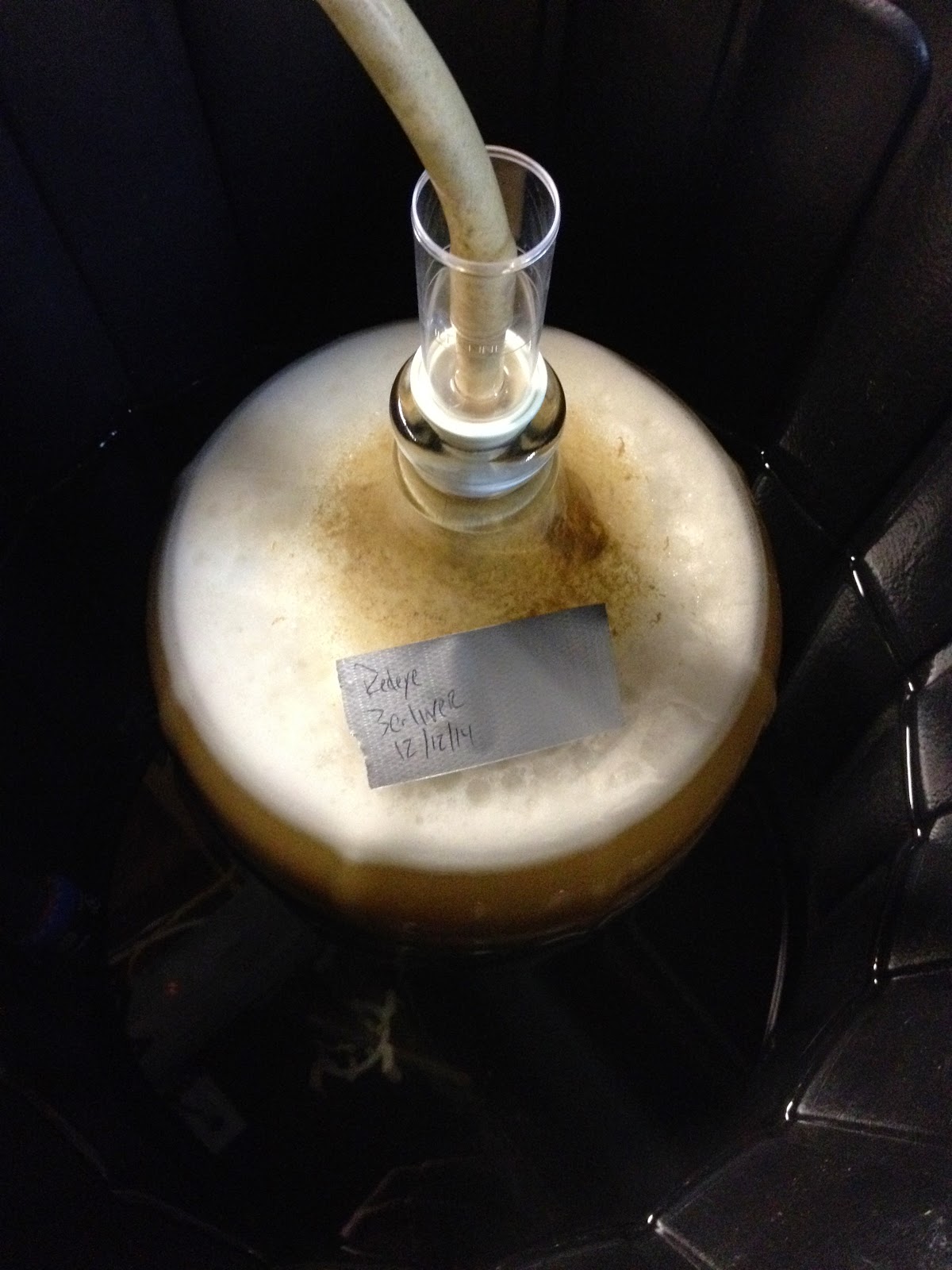
Brew Day

12/13/14 - Brewing off a redeye.  Hence the name.

Brewed with the Mobigs.

Water Target

Added 2tsp gypsum, 2tsp sodium bicarbonate to RO to target Munich.

Mash - 144 (20 mins) then 148 (70 min)
Boil - 15 minutes
Pitch 1 - We made the two 2L starters as described above and both smelled and looked great (we hope, but they were bready, tart, and not stinky).  Half to one batch and half to the other.  No discrimination here.

12/20/14 -Pitch 2 - Split of 400ml of East Coast Ale WLP 008 from thick slurry.  Harvested and washed 2nd gen from Friendsgiving Pale Ale

One portion went to a bucket and the other to glass.  The glass went straight into a warm water bath at 130 degrees.  The other was left out at ambient low 60s.

12/14/14 - D1 - The fermentation is beautiful and strong in the glass.  A gorgeous white foam krausen and rigorous blow off tube activity.  Rigorous.  Water temp in bath is 80 degrees.  Heater is turned to max, nothing more to be done.  Moved bucket to big brew kettle and filled with 130 degree water.  Heater to be placed by MoBigs in that bath.

12/20ish/14 - second pitch accomplished.  Little to no acidity, slightly citric and bready.

1/9/14 - acidity up very slightly, otherwise little change.

4/1/15 - Redeye with Brett C (glass) and hot fermentation - sour/tart/citrus/lemon skin/slight pith, not sweet.  Very faint barnyard, I sweat I smell the fat of Lebanon Babylonia!  Im so happy.  Its starting to sour, quite clean, body is medium-low, but its holding up for 5 Brix.  Quite beautiful. 5 brix.
- Redeye with brett b and cold ferment - also 5
4/25/15 - racked Eric's BW to 7.5lbs fresh diced, uncooked rhubarb.
5/15/15 - racked a gallon to bottling bucket and bottled bombers with 2 sugar tabs and 12oz with one tab.  No CO2 purge. (Pellicle in bottle will not be a surprise).  
5/28/15 - submitting for local beer comp. Fruit beer category, base beer American Wild Ale. It's amazing. Carb is beautiful, fruity buffet with sight tart and citrus and earthy notes and medium plus funk character. Taste is a little thin. But dry dry dry and refreshing. But as tart as elected from fermenter ratings, but that could come in as priming sugar is depleted...We also had just had a cascade apricot sour, so or taste buds were fried. This beer is awesome!
6/15-22 - bottled remaining.  If some found to be low on carb, corn sugar didn't seem homogenize well.  


Friday, November 21, 2014

Falmouth Flanders

Eric Mo'Bigs and I Have set out to make a Flanders Red based off of Jamil's straightforward recipe on BN, only difference is we are going to create multiple worts for blending and just plain old fashion homebrewing fun.  As we know, bugs multiple faster than Sach does, so our plan is to brew with the Rosaleare blend from Wyeast and and let her sit for 2 months (which we have now done).  The next step is to rack the beer and pitch a fresh, identical wort onto the remaining cake in its enirety.  Who knows where this rabbit hole will lead, but it'll be fun running it down!

Grist
39% - Vienna - 5.25 lbs.
39% - Pilsner - 5.25 lbs.
11%- Munich - 1.5 lbs
4% - Aromatic - .5 lbs.
4% - Special B - .5 lbs.
4% - Wheat Malt - .5 lbs.

Hops - .8oz - EKG

Yeast: Roselare - and complete repitch to cake.


Stats
OG - 1056
FG - low low low
ABV - TBD
SRM - 12


We both worked the same process and plan to take a look back in the Spring.

Brew Day

Falmouth Flanders One (FF1)
8/27/14 - Eric brews.  All is as stated above.  Into bucket fermenter.
11/21/14 - TTransferred FF1 to glass.  Initial tasting - Souring and dry. Goood mouthfeel but body low.  Not tart yet but on the away.  Stone fruit accents.  Medicinal taste on the sideline.  On track.

Plan is to oak around January with Medium - M+ oak cubes.

11/21/14 - FF2 Brewed, all is as above.  Harvested cake from FF1 and discarded most the mold that had accrued atop the pellicle.  We should have top cropped the whole pellicle before the transfer.


Next step - top up carboy into neck to reduce  exposure to air.  Need to keep that acetic acid character to a minimum. Was listening to The Sour Hour on BN and they say to not let sours in primary "too long."  I will make it a practice t rack off the primary cake at 3 months and do my initial tasting at that time.  I have been fearful of transferring the beer, but three things need to be considered:

1.  The beer should not age on the primary cake.
2.  3 months is a good time for an initial tasting.
3.  Utilizing good process of CO2 for purging new vessels, purging when doing a tasting and/or transferring and standard sanitation will allow for minimal O2 uptake.
4. I haven't been topping up my carboys after initial fermentation.

1/9/14 - FF1 - on a good trajectory - light funk, low acid.  Did not purge with CO2. Added Hungarian oak cubes
FF2 - same path as FF1 with slightly more funk to date. Purged with CO2.

3/11/15 - FF3 - added 6g baking soda, 5 CaCl and gypsum. - Mash 156.  Same grist as previous. Only adding 2g Warrior at FWH for 5ibu's to let the lacto run a little more.

Racked FF2 to new fermentor.

Better efficiencies these days and I realize I didnt adjust.  Looking for a 1048 preboil gravity to target a 1056 OG. 
 Hit the pre-boil gravity at 6.5G.  2g of Warrior in FWH targeting 5ibu.
Racked wort into FF1/FF2 slurry.  Slurry took up half gallon...also left a pint and change of the beer to grab some active bugs.  Purged both FF2 and FF3.

Tasting FF2 - slight acetic charcter starting to show through.  Malt is forward.  Body is medium-low and finish is bone dry.  Brett funk is lingering as is a tannic charcter. I think FF 2 should get the cherries.
FF1 - has oak
FF2 - cherries
FF3 -

4/1/15 - tasting
FF1 - thin body, acetic apparent, especially on nose, but not overbearing, slight funk, overripe fruit aroma, and in the flavor.  Smooth draw and big vanilla at the end.
FF2 - more ripe fruit than FF1, higher relative funk and a bread aroma, malt, taste is very malty, malty finish, medium-plus body, lingering funk and there is a residual sweetness.  Also smooth.  Funk is a littele more forward on then nose.  There is a medium-low perception of hot alcohol, but only the aroma...not necessarily fussel, but its there.
FF3 - appearance cloudy, but similar color will come with clarity.  aroma is sweet funk, sweet fruit, slight maltiness, no acetic. Not as malty as FF2, perceived bitterness coming from funk, medium body, veryb little sour, but you can tell it starting at a very young age, no lingering funk and perhaps a little percived lingering sourness, almost tannic.  The best start of the three.

7/1/15 - 10lbs thawed black cherries to FF2.

9/1/15 - blending session - 1:1:2, Oak:Yeast:Cherry

Next:
1. blend 3G Cherry versio,/n to 1.5G Yeast, and 1.5G oak in a wild bucket.
2. Take remaining cherry, add to bottling/blending bucket and do the same blend.  Probably 1G cherry, .5G oak, .5G yeast.  Bottle with sugar tabs.  Clean cherry fermenter.
3. Add big batch blend blend from wild bucket to cleaned cherry fermenter.
4. There will be equal amounts of yeast/oak at about 3G each.  Add all yeast version to oak fermenter.  Plan to add fruit and additional lacto to this version later.
5. Harvest yeast.